
trigger point injections (TPIs) deliver a local anesthetic — typically lidocaine — directly into painful muscle knots in the back, breaking the pain-spasm cycle and providing relief that lasts roughly one month per session. When combined with chiropractic care, TPIs address both the soft tissue irritation and the underlying spinal alignment issues that caused the trigger point to form in the first place.
At Aligned Integrated Health in Scottsdale, this integrative approach pairs medical injection therapy with hands-on chiropractic adjustment, giving patients a multimodal pain treatment plan that targets back pain from two directions at once.
What Are Trigger Points and Why Do They Cause Back Pain?
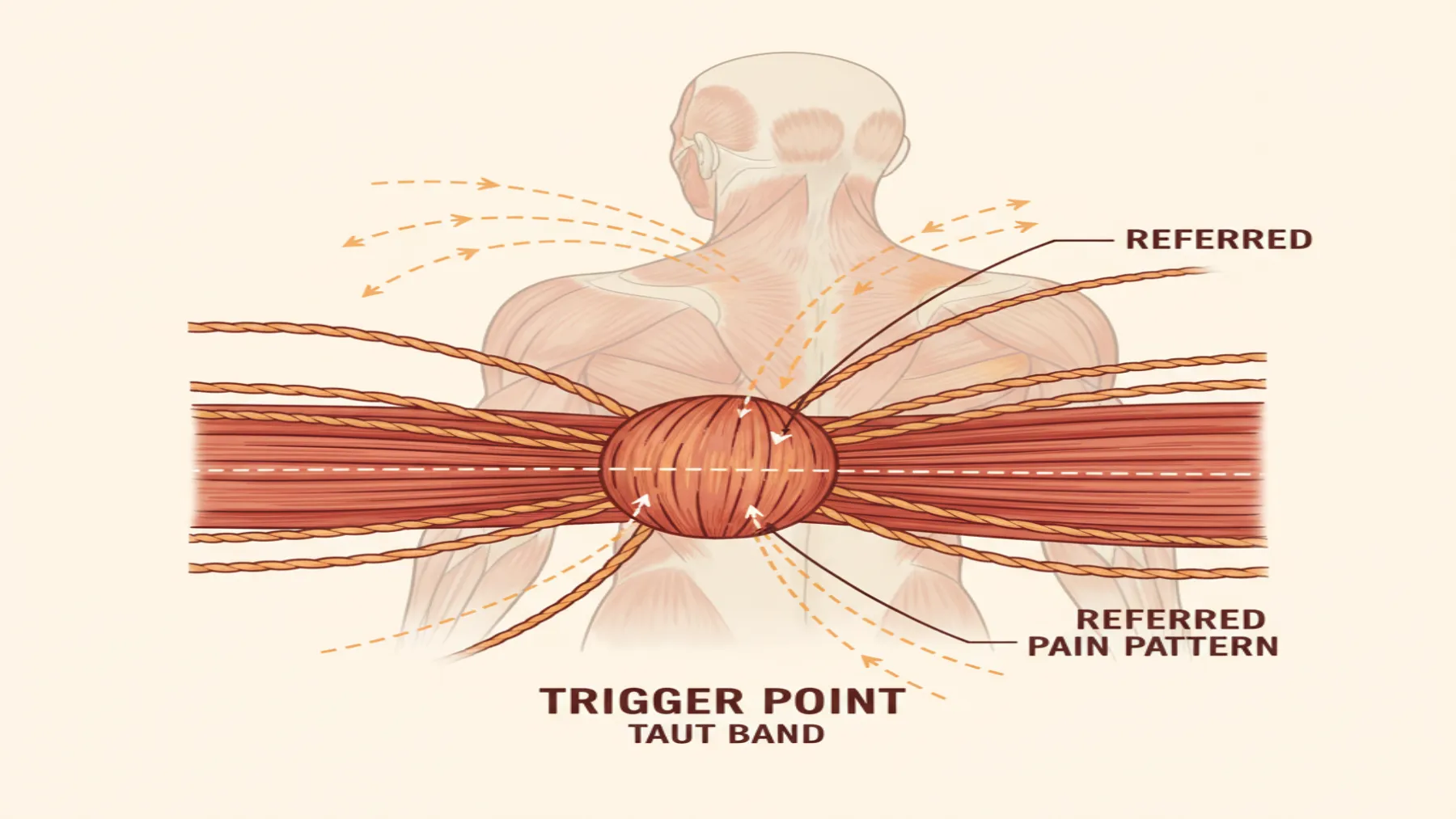
A trigger point is a hyperirritable spot within a taut band of skeletal muscle. These palpable nodules — often called muscle knots — develop when muscle fibers contract and fail to release, creating localized inflammation and restricting blood flow to the area.
What makes trigger points particularly frustrating for back pain sufferers is referred pain. A myofascial trigger point in the quadratus lumborum (a deep lower back muscle) can send pain radiating into the hip, buttock, or even down the leg. A trigger point in the lumbar paraspinal muscles may create a deep, aching discomfort across the entire lower back that worsens with sitting or standing for extended periods.
Active vs. Latent Trigger Points
Not all trigger points behave the same way:
- Active trigger points produce constant pain, muscle weakness, and restricted range of motion. These are the ones driving your back pain symptoms.
- Latent trigger points remain silent until compressed or stressed. They limit flexibility and can activate under physical or emotional stress, suddenly becoming a pain source.
A 2019 study published in the Journal of Bodywork and Movement Therapies found that patients with chronic back pain had significantly more active trigger points in the quadratus lumborum and piriformis muscle compared to pain-free controls (Lluch et al., 2019). Identifying and treating these specific points is the foundation of trigger point injection therapy.
How Trigger Point Injections Work
During a trigger point injection procedure, a clinician inserts a small needle directly into the myofascial trigger point. The injection typically contains:
- Lidocaine — a fast-acting local anesthetic that numbs the area and interrupts pain signals
- Bupivacaine (Marcaine) — a longer-acting anesthetic sometimes used for extended relief
- Corticosteroid — occasionally added when significant inflammation surrounds the trigger point
- Saline — used in wet needling approaches when anesthetics aren't indicated
Some practitioners use dry needling, which involves needle insertion without any injected substance. The needle itself mechanically disrupts the contracted muscle fibers, producing a local twitch response — an involuntary contraction that signals the trigger point has been deactivated.
What the Research Shows
The clinical evidence supporting trigger point injections for musculoskeletal pain is substantial:
- A systematic review in Pain Medicine found TPIs reduce pain scores by 2–3 points on a 10-point VAS pain scale (Cummings & White, 2022)
- The American Academy of Family Physicians reports a 95% success rate for TPIs when combined with physical therapy and rehabilitation (AAFP, 2023)
- Research from Hospital for Special Surgery demonstrated that TPIs can decrease opioid requirements by approximately 50% in patients with chronic myofascial pain syndrome (HSS Pain Management Division, 2021)
These numbers matter, especially as an opioid-sparing treatment alternative for patients managing chronic back pain.
Why Chiropractic Care and Trigger Point Injections Work Better Together
Here is where the integrative model at Aligned Integrated Health differs from what you will find at a standalone pain clinic or a chiropractic office that only adjusts.
Trigger points don't form randomly. They develop in response to:
- Spinal misalignment that forces certain muscles to overcompensate
- Joint dysfunction that creates abnormal movement patterns
- Postural imbalances from prolonged sitting, poor ergonomic correction, or repetitive motion
- Previous injury that altered biomechanics
A trigger point injection treats the symptom — the painful, contracted muscle. Chiropractic care treats the structural cause. Without addressing the underlying alignment issue, trigger points tend to return within weeks.
The Integrated Treatment Sequence
A typical treatment plan combining both modalities follows this progression:
- Assessment — Physical examination identifies active and latent trigger points through palpation, maps referred pain patterns, and evaluates spinal alignment
- Trigger point injection — Targeted injections break the immediate pain-spasm cycle, reducing muscle guarding
- Chiropractic adjustment — With the muscle spasm resolved, the spine becomes more responsive to adjustment. Joints that were locked by muscle tension can now be mobilized effectively
- Rehabilitation exercises — Strengthening and stretching protocols prevent the trigger points from recurring by correcting the movement patterns that caused them
This sequence matters. Adjusting a spine surrounded by severely spasmed muscles is less effective — the muscle tension pulls the joint back out of alignment. Releasing the trigger point first creates a window where chiropractic intervention has its greatest impact.
Common Back Pain Conditions Treated with TPIs
Trigger point injections are particularly effective for these back-related conditions:
| Condition | Key Trigger Point Locations | How TPIs Help |
|---|---|---|
| Myofascial pain syndrome | Quadratus lumborum, erector spinae | Directly deactivates the primary pain generators |
| Chronic lower back pain | Lumbar paraspinal muscles, multifidus | Breaks the chronic pain cycle allowing rehabilitation |
| Piriformis syndrome | Piriformis muscle, gluteus medius | Relieves sciatic-type referred pain without surgery |
| Post-surgical back pain | Scar tissue trigger points | Reduces compensatory muscle guarding |
| Stress-related back tension | Upper trapezius, rhomboids, thoracolumbar fascia | Releases tension patterns driven by sympathetic nervous system activation |
It is worth noting that trigger point injections are not appropriate for every type of back pain. Conditions involving nerve root compression, spinal stenosis, or disc herniation require different interventional approaches. A thorough evaluation determines whether TPIs are the right fit — or whether imaging and further workup are needed first.
What to Expect During and After Treatment
The Procedure
A trigger point injection appointment typically takes 15–30 minutes. The clinician:
- Locates the trigger point through manual palpation (some practitioners use ultrasound-guided injection for deeper muscles like the quadratus lumborum)
- Cleans the injection site
- Inserts a small-gauge needle into the taut band
- Injects the anesthetic solution while redirecting the needle to cover the full extent of the trigger point
- Applies pressure to the area post-injection
Most patients describe the sensation as a deep pressure followed by a muscle twitch, then immediate relief as the local anesthetic takes effect.
Recovery and Aftercare
- Post-injection soreness at the injection site is normal and typically resolves within 24–48 hours
- Ice and gentle stretching help manage any residual discomfort
- Most patients can return to normal activities the same day
- Avoid strenuous exercise for 24 hours following the injection
- Massage therapy between sessions can help maintain the relaxation achieved by the injection
How Many Sessions Are Needed?
Injection frequency varies by individual. Some patients experience lasting relief after a single session. Others with chronic myofascial pain syndrome may need a series of 3–6 sessions spaced 2–4 weeks apart. The goal is always to reduce the number of injections needed over time as chiropractic care and rehabilitation address the root cause.
Trigger Point Injections vs. Other Back Pain Treatments
Understanding where TPIs fit among other options helps you make an informed decision:
TPIs vs. Muscle Relaxants: Oral muscle relaxants affect the entire body, causing drowsiness and cognitive impairment. TPIs target only the problematic muscle with no systemic side effects.
TPIs vs. NSAIDs: Anti-inflammatory medications reduce general inflammation but don't address the mechanical dysfunction of a contracted trigger point. TPIs physically release the contraction.
TPIs vs. Dry Needling: Both use needle insertion to disrupt trigger points. TPIs add anesthetic for immediate pain relief. Dry needling relies solely on the mechanical effect of the needle. Both produce a local twitch response, and research shows similar long-term outcomes (Borg-Stein & Iaccarino, 2014). Your provider can recommend which approach suits your specific condition.
TPIs vs. Epidural Steroid Injections: Epidurals target nerve root inflammation in the spinal canal. TPIs target muscular trigger points. They treat different conditions and are sometimes used together in interventional pain management.
Is This Treatment Covered by Insurance?
Most insurance plans cover trigger point injections when deemed medically necessary. CPT code 20552 (injection of one or two trigger points) and 20553 (injection of three or more trigger points) are standard billing codes. Coverage for the chiropractic component varies by plan. The team at Aligned Integrated Health can verify your specific insurance coverage for trigger point injections before treatment begins.
Take the Next Step Toward Relief
If back pain from muscle knots, myofascial pain syndrome, or chronic muscle spasms has been limiting your daily life, an integrative approach combining trigger point injections with chiropractic treatment may provide the breakthrough you have been looking for.
Aligned Integrated Health in Scottsdale offers comprehensive evaluation to determine whether TPIs are right for your specific condition — and builds a treatment plan that addresses both the pain and its underlying cause.
Schedule an appointment to discuss whether trigger point injections combined with chiropractic care are the right approach for your back pain.
Frequently Asked Questions
How long do trigger point injections last?
Relief from a single trigger point injection typically lasts 2–4 weeks, though some patients experience longer-lasting results. When combined with chiropractic care and corrective exercises that address the underlying cause, each subsequent injection tends to provide progressively longer relief as the structural issues are resolved.
Are trigger point injections painful?
Most patients feel brief pressure and a muscle twitch during the injection, followed by immediate numbness from the local anesthetic. Post-injection soreness — similar to a deep tissue massage — is common for 24–48 hours. The discomfort during the procedure is significantly less than the chronic pain the injection is treating.
What is the difference between trigger point injections and dry needling?
Trigger point injections deliver medication (usually lidocaine) into the muscle knot, providing both mechanical disruption and chemical pain relief. Dry needling uses the needle alone without injecting any substance. Both techniques produce a local twitch response that releases the contracted muscle fibers. TPIs offer faster initial pain relief due to the anesthetic.
Can trigger point injections help with upper back and neck pain?
Yes. Trigger points in the trapezius, levator scapulae, and rhomboid muscles are among the most common sources of upper back and neck pain. The same integrative approach — injections combined with chiropractic adjustment — applies to these areas as well.
How soon can I exercise after a trigger point injection?
Light activity and gentle stretching are encouraged the same day. Avoid intense exercise, heavy lifting, or strenuous activity for 24 hours after the injection to allow the treated muscle to recover. Your provider will give specific guidance based on the location and number of injection sites.
Written by the Aligned Health Team at Aligned Integrated Health, Scottsdale, Arizona. This article is for informational purposes and does not constitute medical advice. Consult a qualified healthcare provider for diagnosis and treatment recommendations specific to your condition.
Published: April 2026 | Last Updated: April 2026