
An integrative chiropractor treats the whole person, not just the spine. Rather than isolating a single symptom, integrative chiropractic care coordinates multiple treatment modalities under one roof to address the root cause of pain, restore function, and support whole-body wellness and long-term holistic health. For patients in Scottsdale, Arizona, this approach means fewer referrals, faster recovery, and a personalized treatment plan built around how your body actually works.
At Aligned Integrated Health, that model — built by a holistic chiropractor in Scottsdale — brings together chiropractic manipulation, structural rehabilitation, massage therapy, applied kinesiology, and nutritional counseling into a single coordinated care plan. That is what a holistic chiropractor Scottsdale patients can actually access, and what chiropractic care Scottsdale clinics should be measured against.
What Makes an Integrative Chiropractor Different
A traditional chiropractor focuses primarily on spinal adjustment. That adjustment matters. It restores spinal alignment, improves nervous system function, and provides drug-free pain relief. But for many patients, the adjustment alone is not the complete answer.
An integrative chiropractor builds on that foundation by combining chiropractic with complementary therapies that reinforce and extend the results. The distinction is coordination: instead of sending you to three separate providers who never talk to each other, an integrated practice designs one treatment plan where each modality supports the others.
Here is why that matters clinically. A spinal adjustment corrects joint position and improves mobility. But if the surrounding soft tissue is locked in spasm, the joint often shifts back within days. Adding soft tissue therapy (myofascial release, trigger point therapy, or deep tissue massage) releases the muscle tension holding the misalignment in place. Then rehabilitation exercises strengthen the corrected position so it becomes the new normal.
That three-step sequence (adjust, release, reinforce) produces longer-lasting results than any single modality alone. It is the core of what functional medicine chiropractic Arizona clinics should deliver in practice.
The Clinical Case for Integrated Care
The research supports what integrative practitioners have observed for decades: combined treatment produces better outcomes.
A 2025 randomized controlled trial published in PMC (N=106) measured the biological effects of 12 weeks of chiropractic spinal adjustments on physiological biomarkers. The chiropractic group showed significantly elevated brain-derived neurotrophic factor (BDNF, p=0.009), reduced TNF-alpha inflammatory markers (p=0.023), and lower long-term cortisol levels at 16 weeks (p=0.024). These are not just pain relief metrics. They demonstrate systemic changes in nervous system function, inflammation, and stress response.
A 2024 study in MDPI Brain Sciences documented neuroplastic responses to chiropractic care, showing measurable improvements in pain processing, mood, sleep quality, and overall quality of life beyond musculoskeletal disorders alone. The finding reinforces the mind-body connection that drives integrative care: the spine is a gateway to the nervous system, and the nervous system influences everything.
The National Institutes of Health (NCCIH) recognizes chiropractic as one of the most widely used complementary health approaches in the United States, with a growing body of evidence supporting non-surgical treatment and its integration with conventional medical treatment.
What Holistic Chiropractic Care Actually Looks Like
The word "holistic" gets used loosely across healthcare marketing. At a functional medicine chiropractic practice, it means something specific: evaluating the whole patient through a whole-person approach (structure, movement, nutrition, lifestyle, and stress) before designing treatment.
The Initial Assessment
A first visit with an integrative chiropractor is longer than a typical medical appointment. It includes:
- Comprehensive health history. Not just "where does it hurt," but sleep patterns, stress levels, diet, lifestyle modification history, exercise habits, prior injuries, and family health history
- Structural examination. Posture analysis, range of motion testing, spinal palpation, and orthopedic testing
- applied kinesiology evaluation. Muscle testing to identify functional imbalances that standard imaging may miss
- Diagnostic imaging. X-rays when indicated to assess spinal alignment, subluxation patterns, and structural integrity
This intake process identifies not just the pain source but the chain of dysfunction behind it. A patient presenting with chronic lower back pain may have a cervical spine restriction creating compensatory movement, a nutritional deficiency slowing tissue repair, and a hip mobility deficit loading the lumbar spine unevenly. Treating only the lower back would address the symptom while leaving three root causes untouched. True root cause treatment requires evaluating every contributing factor.
The Integrated Treatment Stack
Based on the assessment, an integrative chiropractor in Scottsdale builds a personalized treatment plan that draws from multiple modalities:
Chiropractic Spinal Adjustment
Spinal adjustments form the foundation. They restore joint mobility, reduces subluxation, and optimizes nervous system communication between the brain and body. Techniques range from manual high-velocity adjustments to instrument-assisted methods and adjunct therapies like cold laser therapy depending on the patient's condition and preference. Some integrative practices also incorporate PEMF therapy (pulsed electromagnetic field) to accelerate tissue healing at the cellular level.
Structural Rehabilitation and Corrective Exercise Therapy
Traction-based protocols and corrective exercise therapy that gradually restore proper spinal curvature and strengthen supporting musculature. This is the difference between a short-term fix and lasting structural correction, particularly important for patients with loss of cervical lordosis or thoracic kyphosis patterns.
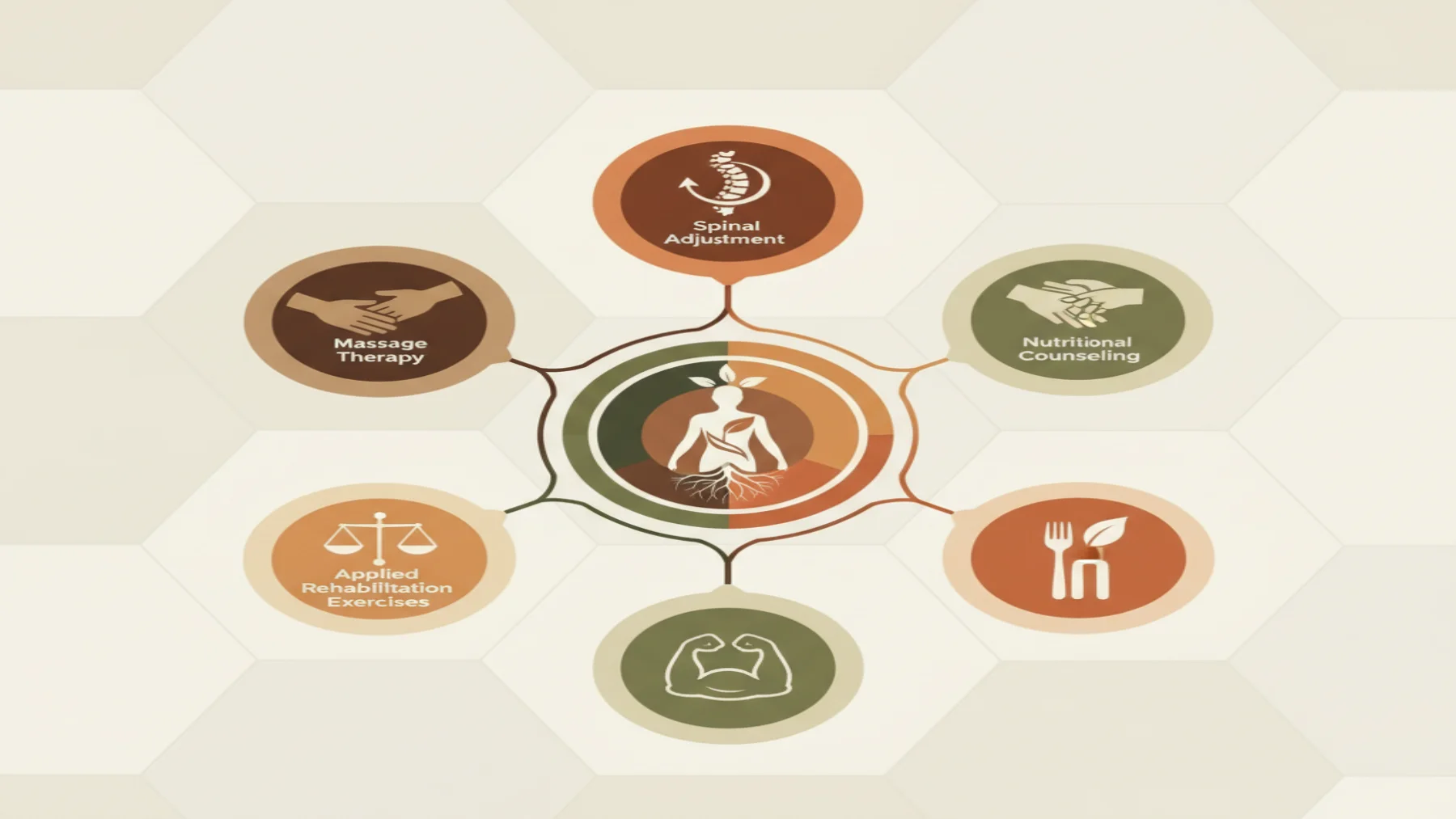
Soft Tissue Therapy
Myofascial release, trigger point therapy, dry needling, Graston technique, and deep tissue work break up adhesions, reduce muscle guarding, and improve blood flow to injured tissue. This prepares the body to hold the chiropractic adjustment rather than pulling against it.
Applied Kinesiology
Functional muscle testing identifies weak links in the kinetic chain that contribute to pain and instability. When a muscle tests weak, the integrative chiropractor can trace the dysfunction to its neurological, structural, or biochemical origin.
Nutritional Counseling
Inflammation, tissue repair, energy production, and immune function all depend on what you eat. A holistic chiropractor addresses the biochemical environment, not just the biomechanical one. Anti-inflammatory nutrition protocols, targeted supplementation, and lifestyle modification support the body's ability to heal and maintain the structural improvements made through hands-on care.
Who Benefits Most from Integrative Chiropractic
Integrative care serves a broad range of patients, but certain groups see the most dramatic results:
Chronic Pain Management: When Single-Modality Care Plateaus
If you have been receiving standard chiropractic adjustments and spinal manipulation or physical therapy for months without lasting improvement, the missing piece is often one of the other modalities. Adding soft tissue work, rehabilitation, or nutritional support can break through a plateau that single-modality care cannot.
Active Scottsdale Residents and Athletes
The Scottsdale lifestyle (hiking, golf, cycling, pickleball, CrossFit) demands a musculoskeletal system that performs, not just one that is pain-free. An integrative approach addresses biomechanical efficiency, preventive care, injury prevention, and recovery optimization for patients who want to do more than simply stop hurting.
Patients with Stress-Related Symptoms
Chronic stress manifests physically: tension headaches, jaw clenching, upper back and neck tightness, digestive disruption, and poor sleep. The mind-body connection means these symptoms respond to the combined effect of spinal adjustment (nervous system regulation), soft tissue therapy (muscular tension release), and nutritional counseling (cortisol and inflammation management). Any holistic chiropractor Scottsdale residents trust should address all three pathways, not just one.
Post-Surgical and Post-Injury Recovery
After surgery or significant injury, the body compensates. Muscles tighten to protect the injured area, movement patterns shift, and spinal alignment changes. Integrative chiropractic care systematically unwinds those compensations through a coordinated sequence of adjustment, rehabilitation, and soft tissue work, restoring normal function rather than simply managing residual pain.
Conditions Treated with Integrative Chiropractic Care
| Condition | How Integrated Care Helps |
|---|---|
| Chronic back pain | Spinal adjustment + rehabilitation + soft tissue therapy addresses structure, stability, and muscle guarding simultaneously |
| Sciatica | Identifies whether compression is discogenic, piriformis-related, or facet-driven, then treats the specific cause |
| Herniated disc | Gentle adjustments and hands-on techniques ease pressure on the disc, while structural rehabilitation restores alignment |
| Tension headaches and migraines | Cervical spine adjustment + trigger point therapy in upper trapezius and suboccipital muscles + stress management |
| Sports injuries | Functional assessment identifies biomechanical faults, treatment corrects them, rehabilitation prevents recurrence |
| Fatigue and brain fog | Nutritional assessment + nervous system optimization through chiropractic addresses root causes beyond "just rest more" |
| TMJ dysfunction | Cervical alignment + applied kinesiology + soft tissue work on jaw and neck musculature |
Integrative Chiropractic vs. Other Approaches
Understanding where integrative care fits helps you make an informed choice:
Integrative Chiropractor vs. Traditional Chiropractor: A traditional chiropractor focuses on spinal adjustment as the primary intervention. An integrative chiropractor uses adjustment as one tool within a broader treatment plan that includes rehabilitation, soft tissue therapy, nutrition, and functional testing. Both share the same foundation. The difference is scope.
Integrative Chiropractor vs. Physical Therapist: Physical therapy emphasizes exercise-based rehabilitation, rehabilitation exercises, and movement retraining. Integrative chiropractic includes those elements but adds spinal manipulation, applied kinesiology, nutritional counseling, and soft tissue therapy. The overlap is in preventative care and rehabilitation; the distinction is in the diagnostic framework and range of modalities.
Functional Medicine Chiropractic vs. Naturopathic Medicine: Both take a whole-person, root-cause approach. Functional medicine chiropractic in Arizona anchors treatment in musculoskeletal assessment and spinal correction, then layers in nutrition and lifestyle. Naturopathic medicine typically leads with botanical medicine, acupuncture, homeopathy, and lab-based protocols. The entry point differs: structure-first versus biochemistry-first.
What to Expect at Your First Visit
Walking into an integrative chiropractic office for the first time is different from a typical medical appointment. Here is what the process looks like at Aligned Integrated Health in Scottsdale Arizona:
- Paperwork and health history (15-20 minutes). Thorough intake covering current symptoms, medical history, lifestyle factors, and health goals
- Consultation with the doctor (20-30 minutes). Dr. Gerwig reviews your history, discusses your concerns, and performs hands-on examination including postural correction analysis, range of motion, and applied kinesiology testing
- Diagnostic imaging if needed. On-site X-rays when structural assessment warrants them
- Findings and treatment plan. Clear explanation of what was found, why it matters, and the recommended combination of modalities to address it
- First treatment session. Many patients begin care on the same day as their initial evaluation
The goal of the first visit is not to "crack your back and send you home." It is to understand the complete picture (structural, functional, and biochemical) so that every subsequent visit builds toward a measurable outcome. This level of patient empowerment, understanding your own body and treatment plan, is central to the integrative model.
Taking the Next Step Toward Holistic Healing
If you have been managing pain with single-modality treatment and the results have been temporary, or if you are looking for a health partner who sees the whole picture rather than just the symptom, integrative chiropractic care may be the approach that changes the outcome.
Aligned Integrated Health offers comprehensive chiropractic care in Scottsdale — the full spectrum of integrative services: chiropractic care, structural rehabilitation, massage therapy, applied kinesiology, and nutritional counseling, coordinated under one roof by a team that communicates about your case.
Schedule an appointment to find out what an integrative treatment plan looks like for your specific situation.
Frequently Asked Questions
What is the difference between a holistic chiropractor and a regular chiropractor?
A regular chiropractor primarily performs spinal adjustments to correct alignment and relieve pain. A holistic chiropractor in Scottsdale takes a whole-body approach, combining spinal adjustment with soft tissue therapy, rehabilitation exercises, nutritional counseling, and functional testing like applied kinesiology. The goal is to treat the root cause of dysfunction, not just manage the symptom.
Is integrative chiropractic care covered by insurance?
Most insurance plans in Arizona cover chiropractic adjustments. Coverage for additional integrative modalities like massage therapy, nutritional counseling, and rehabilitation varies by plan. The holistic chiropractor team at Aligned Integrated Health in Scottsdale verifies your specific benefits before treatment begins so you know what to expect.
How many visits does integrative chiropractic treatment require?
Treatment length depends on your condition and goals. Acute issues may resolve in 4-8 visits. Chronic conditions or structural correction plans typically require 12-24 visits over several months. Your integrative chiropractor will set clear milestones and adjust the plan based on measurable progress, not open-ended "come back forever" scheduling.
Can an integrative chiropractor help with conditions beyond back pain?
Yes. Because integrative care addresses the nervous system, musculoskeletal system, and nutritional status together, patients with musculoskeletal disorders commonly report improvement in headaches, fatigue, sleep quality, digestive issues, stress, and athletic performance in addition to their primary pain complaint.
What should I bring to my first appointment with an integrative chiropractor?
Bring any recent imaging (X-rays, MRI), a list of current medications and supplements, and notes on your health history and current symptoms. Wear comfortable clothing that allows movement for the physical examination. If you have records from previous providers, those help the integrative team understand what has already been tried.
Written by the Aligned Health Team at Aligned Integrated Health, Scottsdale, Arizona. This article is for informational purposes and does not constitute medical advice. Consult a qualified healthcare provider for diagnosis and treatment recommendations specific to your condition.
Published: April 2026 | Last Updated: April 2026