
Desk job back pain affects millions of office workers who spend six to ten hours a day at a sitting desk, and the discomfort rarely resolves without intentional change. Through ergonomic adjustments, targeted exercises, and Services like chiropractic care, most people can find lasting relief and return to comfortable, productive workdays.
By Aligned Health Team, Integrative Health Specialists
Why Sitting All Day Strains Your Spine
The human body was not designed for prolonged sitting, and a desk job puts your musculoskeletal system under steady, cumulative stress. When you sit with poor posture, the natural curve of your lower back flattens, shifting load onto spinal discs and compressing the facet joints. Over time, your back muscles weaken because they are no longer required to hold you upright, and your hip flexors shorten as they remain in a contracted position for hours on end.
Research published by Lis, Jones, and colleagues in Ergonomics (2007) found that workers who sat for more than half their shift reported significantly higher rates of lower back pain compared to those with varied movement patterns. The finding reinforces what chiropractors observe clinically every week: sustained static postures create predictable patterns of dysfunction that worsen without intervention.
The good news is that the causes are correctable. Understanding the mechanics helps you target the right solutions.
Setting Up Your Desk to Protect Your Lower Back
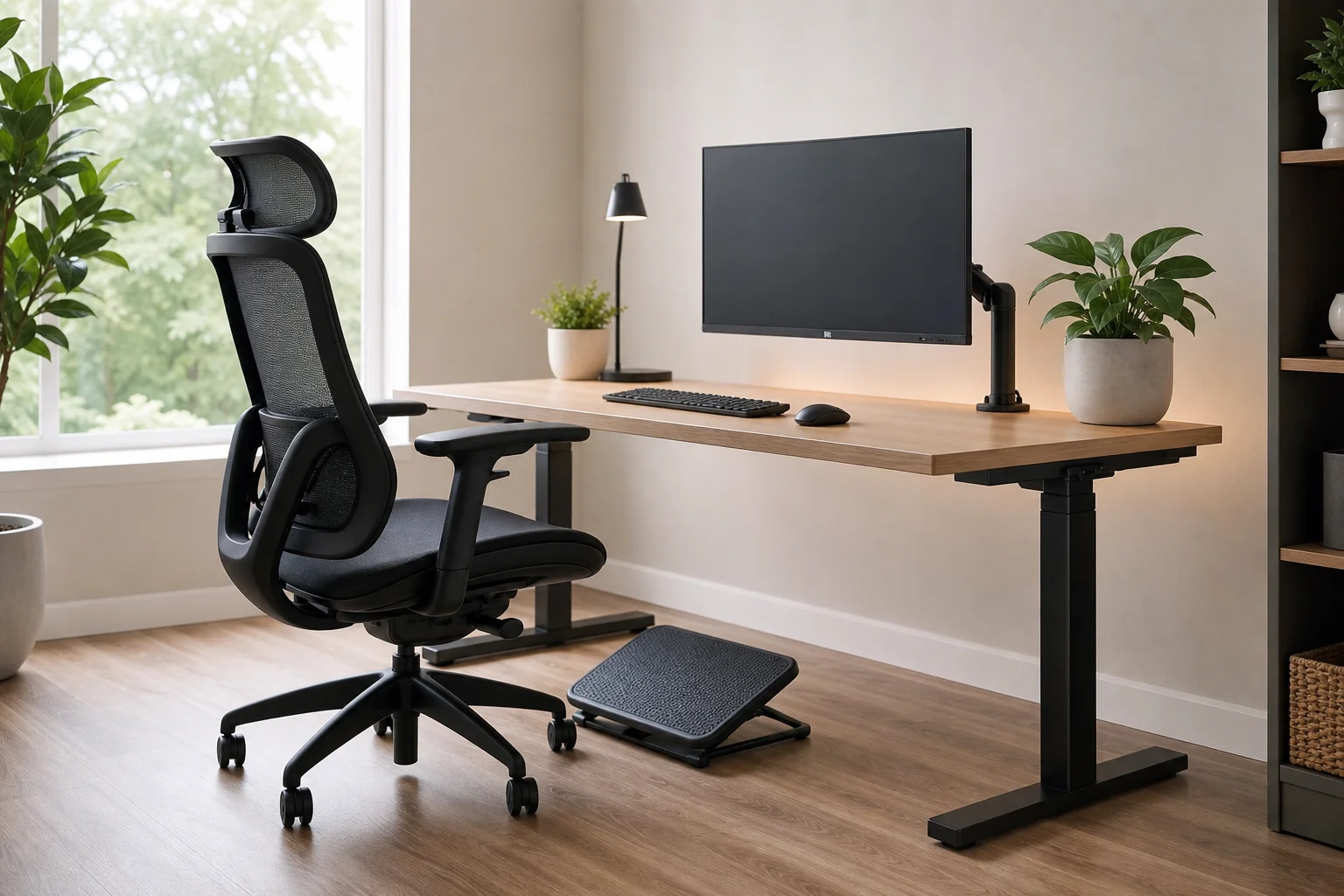
A proper ergonomic setup addresses the root causes of desk job back pain before they become chronic. Start with your chair. Lumbar support is non-negotiable: the backrest should follow the natural inward curve of your lower back, keeping it gently supported rather than slumped. If your chair lacks built-in lumbar support, a rolled towel or a dedicated lumbar cushion works as an affordable fix.
Next, adjust your monitor so the top of the screen sits at or just below eye level. When your screen is too low, your head drifts forward, adding roughly ten pounds of stress to your cervical spine for every inch of forward head position. Over an eight-hour shift, that load accumulates into neck and upper back tension.
Your feet should rest flat on the floor with your knees at roughly a 90-degree angle. If your chair is too high, use a footrest. The flat floor contact distributes weight evenly through your hips and prevents the hip-hiking patterns that torque your lumbar spine. Keep your keyboard and mouse close enough that your elbows stay near your sides, reducing shoulder and upper back strain.
Standing desks help when used correctly. Alternate between sitting and standing every 30 to 60 minutes rather than standing all day, which creates its own fatigue patterns.
Movement Breaks That Reset Your Back Muscles
No ergonomic setup can fully compensate for staying still too long. Short, frequent movement breaks matter more than most people expect. Set a timer for every 45 to 60 minutes. When it goes off, stand, walk for two minutes, and complete a brief stretch routine before returning to your chair.
Three movements that directly counter desk job back pain:
Hip Flexor Stretch
Step one foot forward into a lunge, lower the back knee to the floor, and press your hips gently forward. Hold for 30 seconds per side. This directly counters the shortening of hip flexors that happens during prolonged sitting.
Seated Thoracic Extension
Place both hands behind your head, sit tall, and gently extend your upper back over the top of your chair backrest. Hold for ten seconds and repeat three times. This restores mobility to the thoracic spine, reducing compensatory strain on the lower back.
Cat-Cow Stretch
On hands and knees, alternate between arching your back toward the ceiling and letting it sag toward the floor. Ten slow repetitions lubricate the spinal joints and reactivate the back muscles that sitting tends to quiet.
Building core strength over time also reduces reliance on passive structures like spinal discs and ligaments. Planks, dead bugs, and bird-dogs are low-impact options that build the active support your spine needs throughout a long workday.
Chiropractic Care for Desk Job Back Pain
When ergonomic changes and stretching are not enough, Chiropractic care offers a direct, drug-free path to relief. Chiropractors assess spinal alignment and identify specific joints that have become restricted or misaligned from postural loading. Adjustments restore normal joint motion, reduce nerve irritation, and allow back muscles to function with far less effort.
At Aligned Integrated Health, chiropractic appointments for desk workers typically include a postural assessment, spinal manipulation tailored to your restrictions, and guidance on exercises to continue between visits. The goal is lasting structural correction, not just temporary relief, achieved through an integrative chiropractic approach that considers posture, muscle balance, and daily habits together rather than treating a single joint in isolation.
Desk job pain that has persisted for several weeks often involves trigger points in the lumbar and hip musculature. For these stubborn, deeply rooted cases, chiropractic adjustments can be combined with trigger point injections, a medical treatment that targets those points directly to relieve tension that manual adjustment alone may not fully resolve.
Massage Therapy and Structural Support for Office Workers
Massage therapy is a powerful complement to chiropractic care for desk job back pain. Therapeutic massage reduces muscle tension, improves circulation to oxygen-deprived tissues, and releases the fascia tightness that builds up in hip flexors, glutes, and the paraspinal muscles along the lower back after long hours at a sitting desk. Many patients find that combining massage with chiropractic adjustments produces faster, more lasting results than either treatment alone.
For patients with more complex postural patterns, structural rehabilitation offers a progressive program of corrective exercises designed to retrain how your body holds itself upright. This is especially valuable when desk job pain has been present long enough to create compensatory movement habits throughout the spine and hips.
Frequently Asked Questions
How long does it take to see improvement with chiropractic care for desk job back pain?
Most patients notice meaningful relief within three to six visits, though results vary based on how long the condition has been present and individual anatomy. Chronic postural patterns that developed over years may require a longer corrective phase. Your chiropractor will outline a realistic timeline after your initial assessment.
Can I keep working my desk job while getting treatment?
Yes. Treatment is designed to work alongside your current schedule. Ergonomic adjustments and movement breaks can begin the same day, and chiropractic appointments are typically 30 to 45 minutes with no required recovery time. Most patients return to their desk immediately after a session and find that treatment fits comfortably within a normal workweek.
Is poor posture the primary cause of desk job back pain?
Poor posture is a major contributor, but it works alongside weakened back muscles, shortened hip flexors, and insufficient movement breaks. A thorough chiropractic assessment examines all of these factors rather than posture alone, which is why treatment plans are individualized rather than one-size-fits-all.
What if my lower back pain radiates into my leg?
Radiating pain may signal nerve involvement from a disc issue or a narrowed spinal opening. This warrants prompt evaluation. Chiropractic care is often effective for these presentations, and your provider will determine whether additional imaging or co-management with another specialist is appropriate for your situation.
Does massage therapy help back pain from sitting?
Yes. A 2011 study by Cherkin and colleagues published in the Annals of Internal Medicine found that therapeutic massage provided measurable relief for nonspecific lower back pain, with benefits lasting several months when paired with active self-care strategies like stretching and movement breaks.
Get Lasting Relief from Desk Job Back Pain in Scottsdale
If back pain from sitting is affecting your focus, your sleep, or your daily comfort, a structured plan makes a meaningful difference. Schedule Appointment with the Aligned Integrated Health team today to begin a chiropractic, massage, and rehabilitation program built around your specific patterns and goals.