
Golf and back pain affect an estimated 30 percent of recreational golfers, making it the most common complaint on the course. The rotational demands of the golf swing place concentrated force through the lumbar spine, and Scottsdale players who log frequent rounds are especially prone. Most golfers can achieve lasting pain relief without giving up the game.
Why the Golf Swing Strains the Lumbar Spine
The golf swing is one of the most mechanically demanding motions in recreational sport. At impact, the lumbar spine absorbs compressive and shear forces that can exceed eight times a person's body weight, according to research by Hosea and Gatt published in Clinics in Sports Medicine (1996). That force travels through the lower back in fractions of a second, repeated dozens of times across a single round.
Recreational golfers face higher risk than professionals because amateur swing mechanics tend to rely on the spine for power rather than distributing force across the hips and core. This pattern places the discs, facet joints, and paraspinal muscles under repetitive strain, building the foundation for lower back pain that compounds with every season.
Upper Back Restrictions Drive Lower Back Pain
Golf pain does not always concentrate in one region. The upper back and thoracic spine often become restricted from poor posture at address or a shortened follow-through. When thoracic mobility is limited, the lumbar spine compensates by absorbing rotation it was not built to handle. Golfers frequently report tightness across the upper back alongside the deeper ache at the lower back, and both problems trace to the same movement breakdown.
How Swing Mechanics Contribute to Back Pain in Golfers
Faulty swing mechanics are a primary driver of golf and back pain. A reverse spine angle, where the golfer leans toward the target during the backswing rather than rotating away from it, hyperextends the lumbar spine at the top of the swing. Early extension, where the hips thrust forward through impact, eliminates the hip hinge and forces the lower back to compensate for lost rotation.
Correcting swing mechanics with a qualified instructor reduces the mechanical load on the spine. Paired with conditioning and clinical care, addressing these movement faults is one of the most effective strategies for golfers who want to play golf without constant pain.
Physical Therapy and Chiropractic: A Complete Approach to Pain Relief
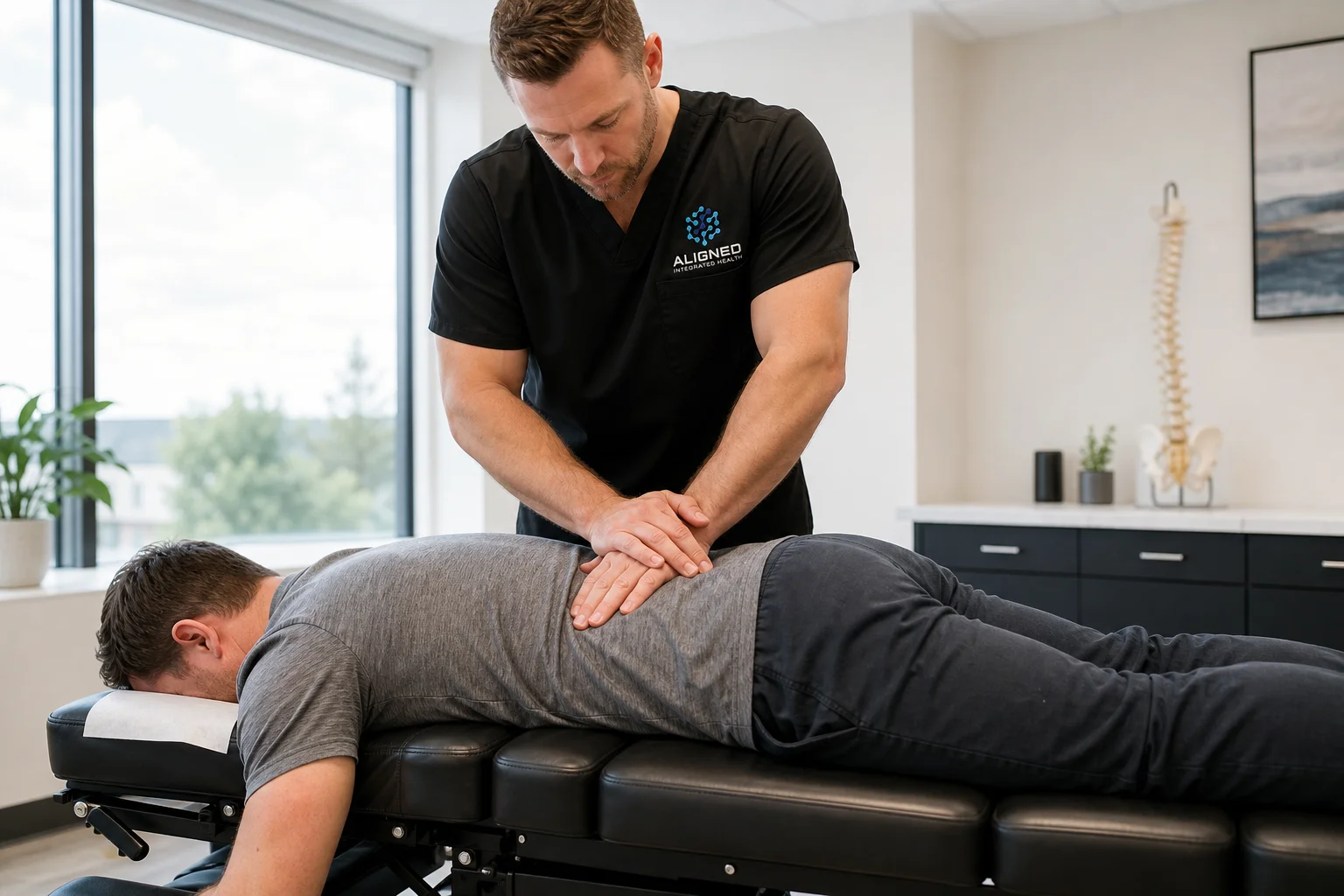
Physical therapy and chiropractic care address golf and back pain from two complementary directions. Physical therapy focuses on restoring range motion, rebuilding core stability, and correcting the muscle imbalances that produce faulty movement patterns. A licensed therapist can evaluate how a patient moves through the full golf swing and design targeted exercises to address weak links before they become injuries.
Chiropractic care addresses structural alignment of the lumbar spine, sacroiliac joints, and thoracic vertebrae. Adjustments restore joint mobility, reduce nerve irritation, and allow muscles to function without chronic guarding. At Aligned Integrated Health, our structural rehabilitation program is designed to correct the root cause of your back pain rather than manage symptoms over time. You can also contact us to discuss which combination of services fits your situation best.
Many Scottsdale golfers find that pairing physical therapy with chiropractic care delivers faster and more lasting results than either approach alone.
Conditioning Exercises That Protect Your Lower Back on the Course
Conditioning exercises are non-negotiable for golfers serious about preventing lower back pain. Golfers with greater core strength place less compressive and rotational stress through the lumbar spine during their golf swings, and the body adapts to those demands when trained consistently.
Core Strength for the Golf Swing
Dead bugs, pallof presses, and single-leg Romanian deadlifts are among the most effective conditioning exercises for golfers because they develop anti-rotation control and hip stability at the same time. These movements prepare the body to stabilize through the golf swing rather than relying on spinal structures to generate and absorb force.
Warm-Up and Stretching Before Every Round
A proper warm-up before you tee off reduces the risk of strain. A ten-minute dynamic stretch sequence targeting hip flexors, thoracic rotation, and hamstrings primes the range motion needed to rotate freely through the golf swing without overloading the lower back. After your round, static stretching of the lumbar spine, hip rotators, and piriformis supports spinal recovery and reduces next-day stiffness.
Tiger Woods, who has undergone multiple spinal surgeries and documented his return to competitive golfing, has spoken openly about how conditioning and mobility work became a non-negotiable part of his daily process. His experience reflects what clinicians at integrative health practices see consistently: lasting spinal health requires a proactive, ongoing commitment, not just care after something breaks down.
Frequently Asked Questions
Can I play golf with lower back pain?
Mild discomfort does not automatically mean you need to stop, but continuing to play golf through back pain without evaluation often worsens the underlying condition. If pain is affecting your swing mechanics or persists more than a few days after golfing, a chiropractic assessment is the right next step. Catching problems early prevents minor strain from becoming a season-ending injury.
What causes lower back pain after a round of golf?
Golf-related lower back pain most commonly results from repetitive rotational stress on the lumbar spine, muscle strain from prolonged walking and standing, and mechanical inefficiencies in the golf swing. Disc irritation, facet joint compression, and core muscle fatigue are frequent clinical findings in golfers who experience back pain after play.
How does chiropractic care help with golf and back pain?
Chiropractic adjustments restore alignment and joint mobility in the lumbar spine, reducing nerve pressure and muscle guarding. For golfers, the result is improved rotation through the swing, less compensatory movement, and faster recovery between rounds. Many patients report meaningful pain relief within a handful of visits.
Are conditioning exercises enough to prevent back pain while golfing?
Conditioning exercises are essential but work best as part of a complete strategy. Core strength, mobility routines, and swing mechanics corrections all contribute to preventing injury. For golfers already experiencing back pain, a clinical evaluation identifies structural problems that exercise and stretching alone cannot resolve.
How long does recovery from golf-related back pain take?
Recovery depends on injury severity and how quickly care begins. Muscle strain often improves within one to two weeks with appropriate treatment. Disc-related pain or chronic lower back conditions typically involve a longer process of physical therapy, chiropractic treatment, and guided conditioning. Early action consistently leads to faster, more complete outcomes.
Ready to Play Golf Without Back Pain?
If golf and back pain are affecting your game or your daily life, the team at Aligned Integrated Health can help you build a clear path to lasting relief. Schedule an appointment today and take the first step toward getting back on the course.