
If your feet ache after a long day, or your knees and lower back seem to flare up without warning, custom foot orthotics in Scottsdale may address the real source of the strain: misaligned arches. Paired with Structural Rehabilitation, custom orthotics correct how your feet strike the ground, easing pressure that travels up through your knees, hips, and spine.
By Aligned Health Team, Integrative Health Specialists
Why Arch Support Shapes Whole-Body Posture
Your feet are the foundation for every step, squat, and stride you take, and when that foundation is off, the effects rarely stay contained to your feet. Flat arches, high arches, and uneven pronation change the angle at which your ankles, knees, hips, and spine absorb impact with each stride. Over months and years, that misalignment compounds, showing up as knee strain, hip tightness, or a low back that never quite feels settled, even after rest.
The American Podiatric Medical Association has long noted that proper arch support influences alignment well beyond the foot itself, which is why custom orthotics are built around your specific gait and arch pattern rather than a generic mold. At Aligned Integrated Health, we treat the feet as part of the same kinetic chain we address through Chiropractic care, not as a separate issue tucked away from the rest of your body.
This whole-body view matters because two people with the same knee pain can have entirely different root causes. One patient's discomfort might trace back to a hip rotation issue, while another's stems from a collapsed arch that has quietly changed how their entire leg tracks with every step. Custom orthotics give us a way to correct the ground-level cause instead of only treating where the pain happens to surface.
Warning Signs You May Need Custom Foot Orthotics
Not every ache means you need orthotics, but a few patterns are worth paying attention to. Uneven wear on the outside or inside edge of your shoe soles often points to overpronation or supination. Heel pain that is sharpest with your first steps in the morning is a classic sign of plantar fasciitis, which custom orthotics are frequently used to manage. Recurring knee, hip, or low back pain that has no obvious injury behind it can also trace back to how your feet distribute weight.
Other signs are easy to overlook because they show up far from the feet. Frequent ankle rolling, calluses in unusual spots on the sole, or shoes that always feel tight in the same place after a few months of wear all point toward an arch that is not supporting your foot the way it should. Some patients also notice their gait has changed after an old injury, pregnancy, or years on their feet at work, which shifts weight distribution gradually enough that it is easy to miss day to day.
If you stand or walk for long stretches at work, or you have noticed your posture changing over the past year, custom foot orthotics in Scottsdale are worth discussing at your next visit. The earlier a misalignment is corrected, the less compensation your joints have to absorb over time.
How Custom Foot Orthotics in Scottsdale Are Fitted and Made
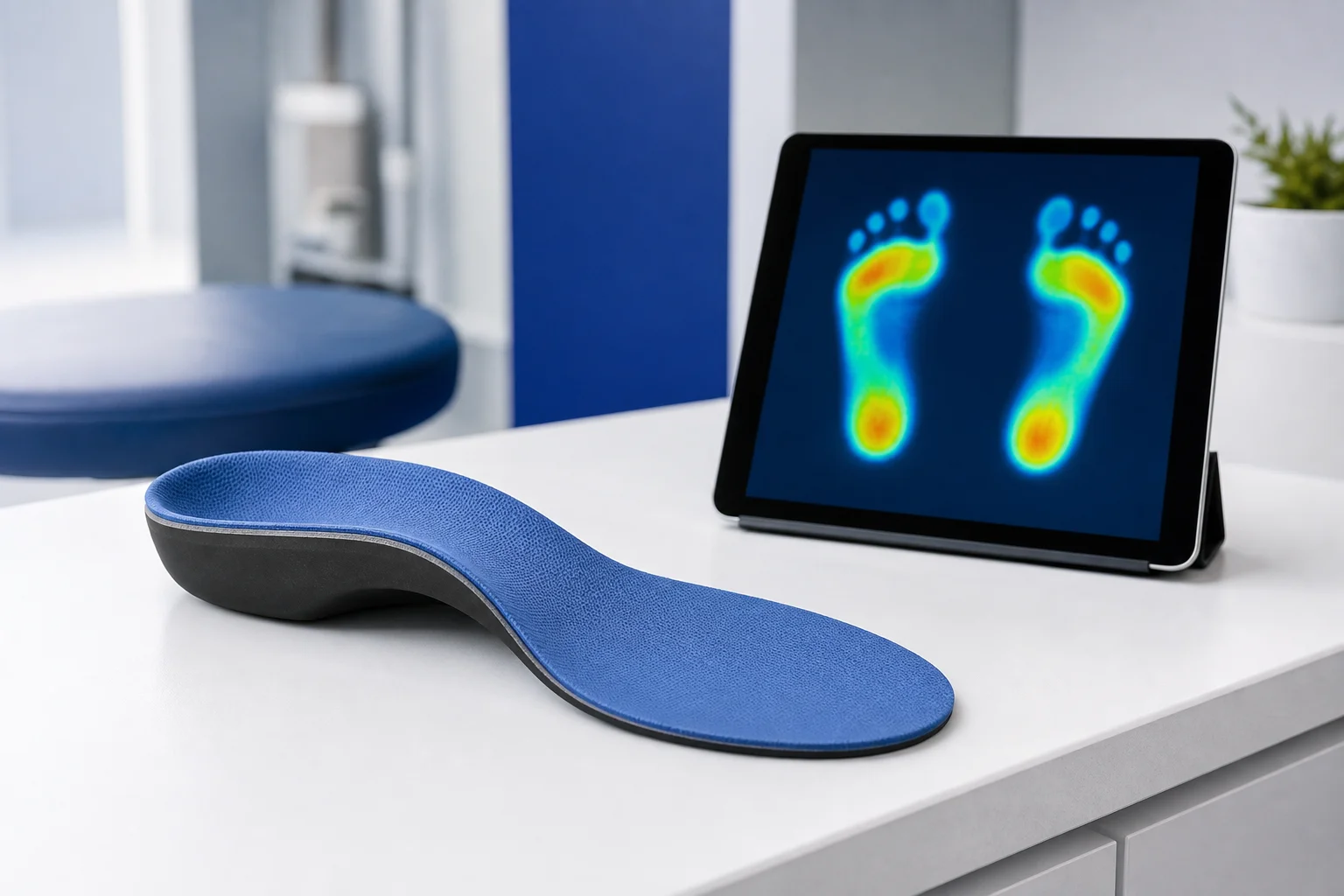
Custom orthotics start with a gait and posture assessment, not a shoe size. Our team observes how you stand, walk, and bear weight, then takes a detailed impression or scan of each foot's unique arch shape. That data becomes the blueprint for an orthotic built specifically for your feet, rather than an over-the-counter insole shaped for an average foot that does not exist.
What Goes Into the Build
Custom orthotics are constructed in layers, a rigid or semi-rigid base for structural support, a cushioning layer for shock absorption, and a top cover matched to how the orthotic will be used. Someone who needs support for long shifts on their feet may need a different build than a runner managing a sports injury, which is why the assessment stage matters as much as the materials themselves.
The Fitting Visit
Once your custom foot orthotics are ready, we fit and adjust them in person, checking how they change your stance and stride before you leave. Most patients notice a difference in how their shoes feel within the first few days, though full adaptation to a new gait pattern can take a few weeks. We ask patients to bring the shoes they wear most often to this visit, since fit and volume vary between sneakers, work boots, and dress shoes.
The Link Between Foot Alignment and Chronic Pain
Foot alignment rarely stays isolated. Uneven arches change how your knees track, which shifts your hip position and eventually alters the curve of your lower spine. We see the same compensation pattern in patients who sit at a desk for long hours, where tight hips and a rounded low back gradually pull posture out of alignment, and in those who spend the day looking at a screen, where the head drifts forward and adds strain through the neck and upper back. Posture problems rarely have a single cause, and the feet are one of the most overlooked pieces of that puzzle.
Athletes are not exempt either. Golfers who rotate through an unstable arch often develop hip and low back pain, a connection we see often in golfers' back pain cases. Weekend athletes managing new injuries also benefit from the same gait analysis, which plays a central role in our approach to sports injury treatment. Even patients who are not active athletes can develop similar strain simply from years of standing on an unsupported arch during long work shifts.
Custom orthotics will not undo years of compensation overnight, but they remove one of the more common root causes seen repeated across these conditions: a foot that is not supporting the body the way it should. Combined with hands-on care, that correction tends to hold better and longer than treating the pain site alone.
Frequently Asked Questions
What are custom foot orthotics and how are they different from store-bought insoles?
Custom foot orthotics are built from an impression or scan of your specific foot and gait pattern, then shaped to support your unique arch. Store-bought insoles are mass-produced in a handful of generic sizes and cannot correct for pronation, supination, or leg length differences. Custom orthotics are designed to change how your foot functions, not just cushion it.
How do custom foot orthotics in Scottsdale help with back and knee pain?
Because your feet are the base of your kinetic chain, an unsupported arch changes how force travels up through your ankles, knees, hips, and spine. Correcting that foundation with custom orthotics reduces the compensation your joints make with every step, which often eases pain that seemed unrelated to your feet in the first place.
How long does it take to get used to custom orthotics?
Most patients adjust within one to three weeks of regular wear. It is normal to feel mild soreness in the arch or calf as your foot adapts to a new alignment. We recommend easing into daily wear rather than switching all at once, and checking in with our team if discomfort lasts longer than a few weeks.
Will insurance cover custom foot orthotics?
Coverage varies by plan and by the medical necessity documented for your case. Some plans cover a portion of custom orthotics when they are prescribed as part of a broader treatment plan. Our team can help you understand what your specific plan allows during your visit.
How often do custom orthotics need to be replaced?
Most custom orthotics last one to three years, depending on how often they are worn and how much wear your shoes take on. Active patients, or those on their feet most of the day, may need a replacement closer to the one-year mark, while patients with lighter daily use often get more life out of the same pair.
Get Fitted for Custom Foot Orthotics in Scottsdale
Lasting pain relief often starts at the ground up. If your feet, knees, or back have been telling you something is off, Schedule Appointment to get a gait assessment and find out whether custom orthotics are right for you.